

Share
What changed on 9 November 2026?
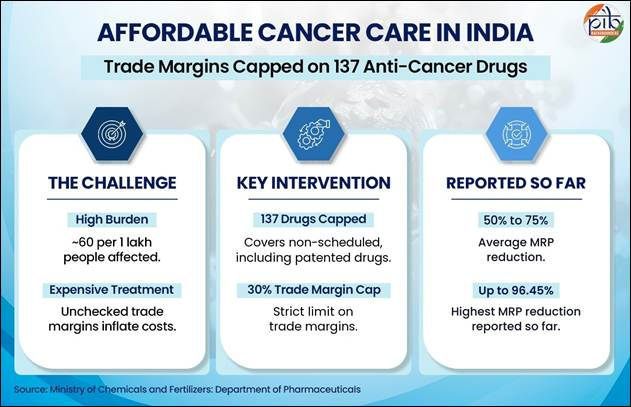
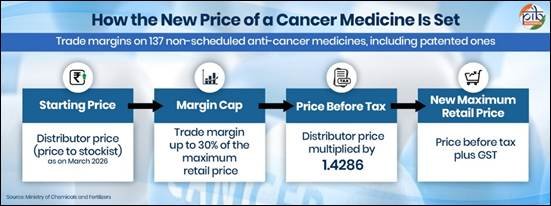
From 9 November 2026, revised maximum retail prices (MRPs) took effect for affected packs of medicines covered by India’s latest cancer pricing order. The National Pharmaceutical Pricing Authority (NPPA) set a 30% limit on the trade margin for non-scheduled formulations of 137 listed medicines. These are medicines or formulations outside the government’s regular essential-medicines price schedule.
The trade margin is the part of the pre-tax maximum price that sits between the manufacturer’s selling price to a distributor and the maximum price charged to the patient. With a distributor price of ₹70, a 30% margin gives a maximum price of ₹100 before applicable GST. Each brand starts from its own distributor price and previous MRP, so the size of any reduction varies. The order directs manufacturers to keep the existing MRP if it was already below the calculated maximum.
What the government reported
In its 9 November announcement, the Press Information Bureau (PIB) said 85 companies had submitted revised MRPs covering 121 of the 137 medicines by 8 November. It reported MRP reductions above 50% for 679 brands and estimated annual consumer savings of about ₹3,540 crore. Your own saving depends on the exact pack and what you previously paid. Some listed medicines had yet to launch, and the order provides for covered products when they are marketed.
Read the government documents
Keep the official announcement with your treatment-cost discussion.
Search medicines in the 2019 and 2026 orders
Search the generic name printed on your prescription. The numbers show where the medicine appears in each order. A dash means there is no matching entry in that order. The two lists overlap, and similar names can refer to different formulations.
The index shows which orders name the medicine. For a current price, match the brand, strength, formulation and pack in NPPA’s records. The 2019 column is historical.
How the 2019 pilot led to the new order
2019. The first 42 medicines
NPPA capped trade margins at 30% for 42 selected medicines in 2019. The recalculated prices were fixed for one year. In 2020, NPPA directed that these prices be monitored under the rule that generally limits MRP increases to 10% over 12 months.
2022. Some pilot medicines entered the essential-medicines list
The National List of Essential Medicines (NLEM) added specific forms of bendamustine, irinotecan, lenalidomide and leuprolide acetate. The list names leuprolide acetate powder for injection in 3.75 mg, 11.25 mg and 22.5 mg strengths. These scheduled formulations have a separate ceiling-price system.
2026. A broader order with a new price basis
NPPA used its public-interest powers again after finding high mark-ups and differences between retail and hospital prices. An expert committee recommended the new list. The 2026 calculation generally uses March 2026 distributor prices. Comparing the two official tables, CTI matched 34 entries by medicine and formulation wording. Azacitidine, bevacizumab, enzalutamide, pegfilgrastim and pemetrexed appear in both. Pembrolizumab, palbociclib and datopotamab deruxtecan are examples of entries on the 2026 list that were outside the 2019 pilot.
Why some medicines are outside the 2026 list
Some formulations already have a ceiling price
Check Schedule I for the exact form and strength. For example, imatinib 100 mg and 400 mg tablets, rituximab 10 mg/mL injection and letrozole 2.5 mg tablets are listed in NLEM 2022. The 2019 order specifically noted that it left imatinib out of the pilot because it was already scheduled.
Check the formulation even if you recognise the drug name. Ordinary irinotecan HCl 20 mg/mL solution for injection is on the essential-medicines list. Pegylated liposomal irinotecan is a separate entry in the 2026 trade-margin order. Likewise, a listed standard paclitaxel injection and the protein-bound paclitaxel in the 2019 pilot are different formulations.
Some entries were in the 2019 pilot only
Eight 2019 entries have no matching 2026 entry. Five have specific forms in NLEM 2022. They are bendamustine 25 mg or 100 mg per vial, bortezomib 2 mg powder for injection, irinotecan 20 mg/mL injection, lenalidomide 5 mg or 25 mg capsules and leuprolide acetate powder for injection at the strengths listed above.
The other three entries are pegylated liposomal doxorubicin, olaratumab and protein-bound paclitaxel. The published order gives no product-specific reason for those omissions.
Some medicines appear in neither trade-margin order
Belzutifan and trastuzumab deruxtecan are examples. The 2026 order applies to the committee’s selected list, which includes some patented medicines. The published material reviewed does not explain each omitted drug. An absent name does not tell you whether a specific product has a separate notified retail price or exemption.
For a non-scheduled formulation, paragraph 20 generally limits MRP increases to 10% over the preceding 12 months. That rule limits increases and does not set the starting price. Paragraph 32 provides exemptions in specified circumstances. Check for a current, product-specific order before assuming an exemption applies.
Search published brand prices
The table shows 38 reductions from the government’s 7 November release and two unchanged prices from NPPA’s 11 November list. For other brands and pack sizes, use NPPA’s current records. The government summary omits tablet and capsule counts, so check the exact oral pack before budgeting.
What this could mean for your bill
PEG FILTERO
Keytruda
The MRP for one PEG FILTERO 6 mg prefilled syringe (pegfilgrastim) fell from ₹9,093 to ₹1,631, a reduction of ₹7,462 per syringe (82.1%).
The 11 November NPPA list shows no change for Keytruda 100 mg (pembrolizumab, ₹2,16,500 per vial) or Onivyde 4.3 mg/mL (pegylated liposomal irinotecan, ₹86,710 per vial). The order requires a cut when the old MRP exceeds the calculated limit. The published price list gives the result for each pack and leaves out the distributor prices needed to check each calculation.
How to check your next bill
- Match the generic name, brand, strength, formulation and number of tablets, vials or syringes in the pack.
- Ask the pharmacy to show the current MRP for that pack and the amount it will actually charge. If older stock carries a higher printed price, ask to see the revised price list.
- Compare your previous invoice with an itemised quote for your next cycle. Ask which costs are for medicines and which are for tests, infusions or other hospital services.
- If you use a manufacturer assistance programme, ask for the current paid and free supply terms in writing and compare the cost over your planned course. The 2026 order allows qualifying free supplies and direct government sales to be excluded from the calculation of the margin cap.
If you think you were charged above the revised MRP, keep the prescription, pack details and itemised bill. You can check the price in Pharma Sahi Daam and report a discrepancy through Pharma Jan Samadhan or NPPA’s helpline at 1800 111 255.
For help planning your treatment budget, see Care, costs and support. If you’re comparing brands, read our guide to generic and biosimilar cancer medicines. If you’re budgeting for care in another city, see planning treatment away from home.
Discuss any change of medicine, brand, dose or schedule with your cancer team.
Sources and further reading
Sources checked on 13 November 2026. The lookup compares Table B of S.O. 1041(E) and Table B of S.O. 5690(E). Some official spellings are retained, with common alternative spellings searchable. Matching an entry establishes list membership. For the latest price of a particular pack, use NPPA’s current product records.
- 2019 notification, 27 February 2019 (NPPA archive). Find the trade-margin notification for selected non-scheduled anti-cancer drugs.
- NLEM 2022 committee report, oncology review (PDF) and National List of Essential Medicines, section 7 (PDF).
- 2026 notification, 17 October 2026 (PDF) and Government explainer with the 137 medicine entries.
- Government release with brand price examples, 7 November 2026 and NPPA’s updated brand and pack price records.
Medically approved by Dr (Prof) Vijay Agarwal
Professor and Lead Consultant – Medical Oncology
