

Share
Choosing how treatment reaches your bloodstream
If you need treatment through a vein, you and your team will decide how to give it safely and comfortably. A peripheral cannula (a short tube in a hand or arm vein) may be entirely suitable. Other people benefit from a peripherally inserted central catheter (PICC, a longer line placed through an arm vein) or an implanted port under the skin, often called a chemoport or Port-a-Cath (also written portacath). No single device is best for everyone.
Venous access means a way to reach a vein for treatment. It is relevant to chemotherapy given into a vein (intravenously), immunotherapy, targeted medicines and antibody-drug conjugates (ADCs). It may also support fluids, antibiotics, transfusions and blood sampling. Tablets and injections under the skin do not need a venous device just to give that medicine.
The choice depends on the actual medicines and infusion length, how often and how long treatment is planned, your veins, previous clots or infections, and your preferences. For longer courses of intravenous treatment, a chemoport is often the preferred option when medically suitable: it avoids an external line between visits and usually needs less frequent maintenance than a PICC. A port is not automatically necessary because you have cancer.
Cannula, PICC or port: a comparison
If the table extends beyond your screen, swipe or scroll sideways to read every column.
| What matters | Peripheral cannula | PICC | Implanted port / chemoport |
|---|---|---|---|
| Where it sits | A short plastic tube in a hand or arm vein. | Enters an upper-arm vein; its tip lies in a large central vein near the heart. | A chamber beneath the skin, usually on the chest, connected to a thin tube (catheter) in a large central vein. |
| Typical use | A treatment visit; usually removed afterwards. | Weeks to months, while needed and working safely. | Months to years when still needed, with ongoing maintenance. |
| Needles for treatment | A new cannula is usually needed at each visit. | No new skin puncture to use the existing line. | A special needle goes through the skin into the port at each new access. |
| Between treatments | No device remains after removal. | External tubing and a dressing remain. | Nothing external when healed and the access needle is removed. |
| Maintenance | No line care after removal. | Weekly hospital visits for dressing changes and line care, including flushing as prescribed. | Flushing after use and once a month when not being used. |
| Children and pets at home | No tubing to protect once removed. | External tubing needs protection from accidental pulling, chewing or contamination. | No external tubing when healed and not accessed; protect needle and tubing during infusions. |
| Everyday life | Few restrictions after removal. | Keep dressing dry; protect tubing; do not swim or submerge it. | Swimming may be possible after full healing, with no needle in place and team approval. |
| Main trade-off | Repeated needles and possible vein irritation or leakage. | Convenient central access, but external care, clotting, infection and displacement risks. | An insertion/removal procedure and access needle, but less day-to-day care when not accessed. |
These are general differences, not fixed rules. Blood samples can often be taken through a PICC or port, but a separate needle may sometimes still be needed. A PICC is a central line despite entering through the arm.
Peripheral cannula: a fresh line for each visit
A cannula is a short plastic tube placed in a suitable vein, usually in the forearm or hand. The insertion needle is removed, leaving the soft tube during treatment. It is usually removed before you go home.
This may suit a shorter course, easily accessible veins and medicines that can safely be given peripherally. It avoids a long-term device, a separate insertion procedure and care between visits.
The disadvantages are repeated needle insertion, discomfort, vein inflammation (phlebitis) and possible leakage into surrounding tissue. If finding a vein becomes difficult or distressing, ask to review the plan rather than struggling through repeated attempts.
Some tissue-damaging medicines can be given peripherally under specific protocols with careful vein selection and close observation; others or their infusion schedules require central access. Your chemotherapy team must decide this for your exact regimen. The number of cycles alone does not determine the answer.
PICC: central access through the upper arm
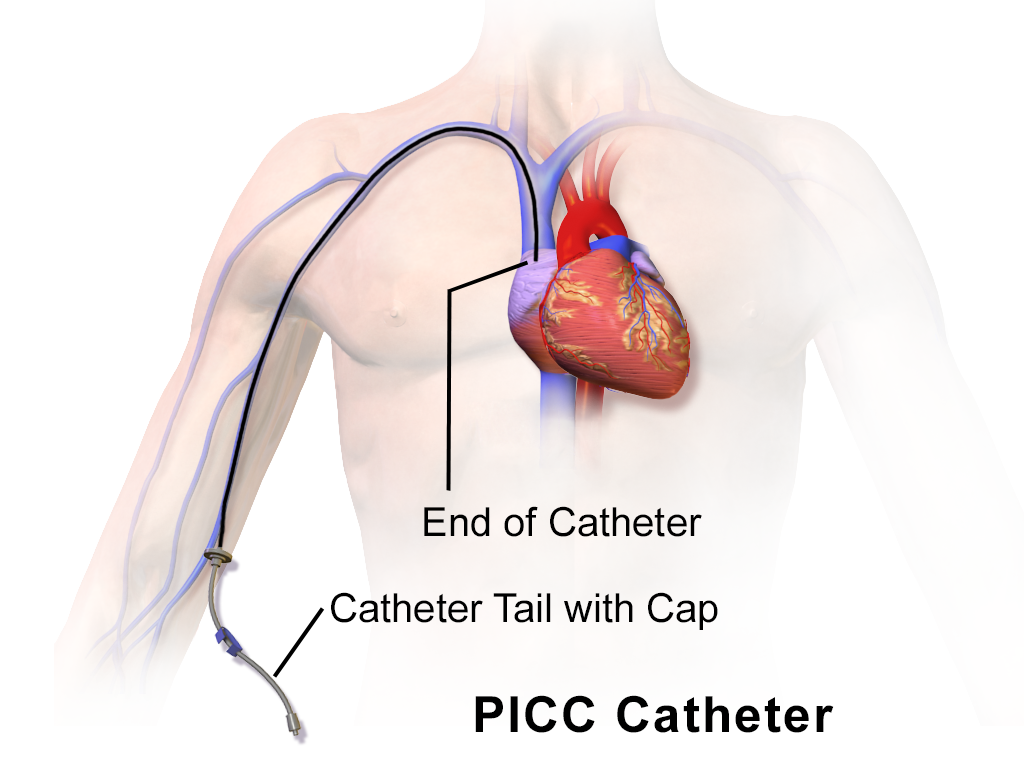
A PICC is a thin flexible tube that enters an upper-arm vein and travels to a large vein close to the heart. A short portion remains outside the arm, covered and secured with a dressing.
Insertion usually uses medicine to numb the area (local anaesthetic), with ultrasound to select the vein. The team confirms the tip position using an appropriate method, such as guidance from the heart’s electrical signals (electrocardiogram, ECG) or imaging, before use. A PICC can provide access for weeks or months if it remains needed and functions safely.
Its advantages include avoiding repeated cannulas, straightforward access for treatment and often blood tests, and relatively simple removal. It can be useful when central access is needed promptly.
The trade-offs are the external tubing and ongoing maintenance. Infection, blockage, displacement and a clot in the arm vein can occur. You should plan to return to hospital every week for PICC dressing changes and line care, including flushing as prescribed, even in weeks without treatment. This adds travel, time and cost. If your team explicitly arranges a suitable trained home-care service, follow that agreed plan instead.
Chemoport / Port-a-Cath: access beneath the skin
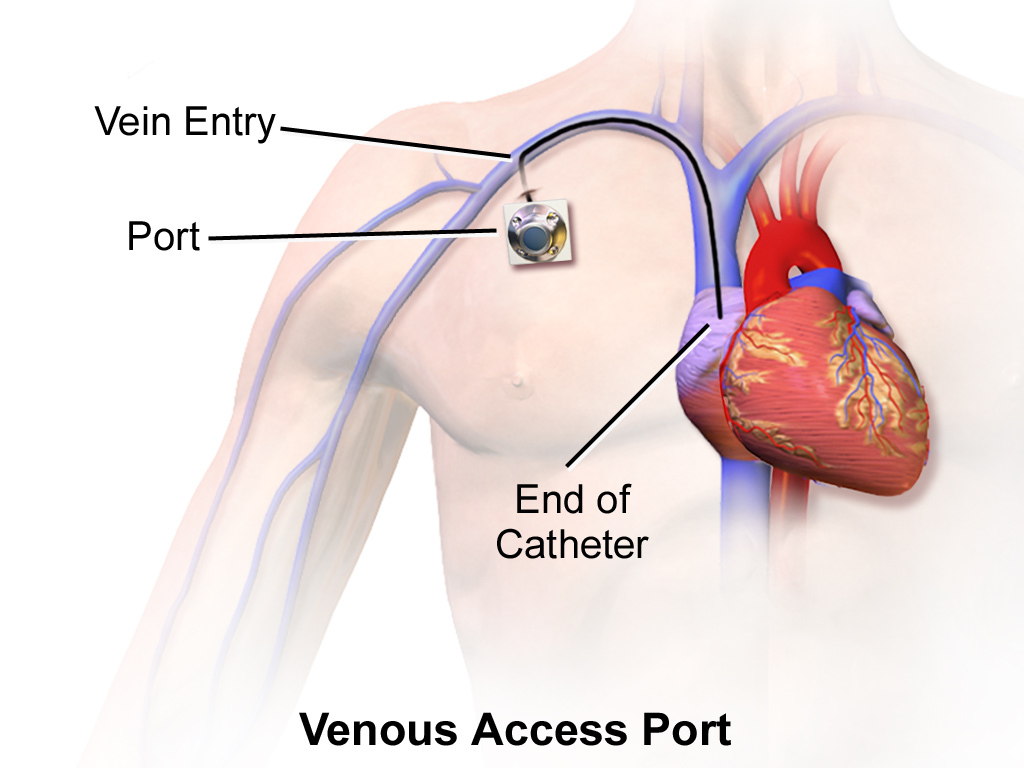
An implanted venous port is commonly called a chemoport. Port-a-Cath is a brand name also commonly used for this type of device; you may see it written as portacath.
A port is a small chamber beneath the skin, usually on the upper chest, connected to a thin catheter in a central vein. You can usually feel a small bump. Once healed and not accessed, there is no external tubing or dressing.
Insertion involves making a small pocket under the skin and positioning the catheter. Local anaesthetic, sometimes with medicine to help you relax (sedation), is commonly used; the approach varies with the patient. Discuss comfort, clothing, seatbelts and the planned position before insertion.
For treatment, a trained practitioner cleans the skin and inserts a special non-coring (Huber) needle into the port. Ask about numbing cream if needle discomfort worries you. For a continuous infusion, the needle remains secured under a sterile dressing and connects to the pump.
A port can be convenient for repeated or prolonged treatment and may remain for months or years while useful. It still needs maintenance, and insertion and removal require procedures. Infection, blockage, blood clots (thrombosis) and device problems remain possible. Early risks include bleeding and placement complications; rarely, a chest insertion can cause a collapsed lung. Your insertion team explains the risks relevant to your procedure.
What did the CAVA study show?
CAVA (Cancer and Venous Access) was a randomised study comparing central venous devices in adults having anticancer treatment planned for at least 12 weeks. Compared with PICCs, implanted ports had fewer overall device-related complications and fewer catheter-related blood clots. This supports choosing a chemoport for many patients needing prolonged intravenous treatment, while taking individual risks, practical needs and preferences into account.
Making the choice together
- A cannula may suit a limited course when the regimen allows it and your veins remain easy to access.
- Discuss central access for difficult veins, repeated painful cannulation, frequent treatment or prolonged infusions, including many portable-pump fluorouracil schedules.
- A PICC may suit a need for prompt access or a preference to avoid a port pocket, provided regular care is practical.
- For prolonged intravenous treatment, a chemoport is often preferable when medically suitable, with less maintenance between visits and no external tubing when not accessed. Discuss it early rather than waiting for veins or repeated PICC care to become difficult.
Tell the team about previous clots, line infections, blood-thinning medicines, bleeding problems, kidney disease or dialysis plans, pacemakers, lymphoedema, previous breast or armpit surgery, and skin or dressing allergies. These may change the site or device choice; they are not all automatic exclusions.
Ask for the total expected cost, including insertion, access needles, dressing visits, flushing and removal. Costs and scheme coverage vary; the cheapest insertion does not necessarily mean the lowest total cost. You can revisit the choice if your treatment or veins change.
Why a chemoport often suits longer treatment
If your chemotherapy protocol lasts many months, or you are likely to receive repeated courses of intravenous treatment, we generally favour discussing a chemoport early. It can provide durable access, reduce the burden of weekly PICC dressing visits and be easier to live with between treatments. The comparative evidence also supports a lower risk of catheter-related thrombosis than with a PICC.
This is particularly relevant when cancer cannot be cured but treatment may control it for a long time. If ongoing or successive intravenous treatments are anticipated, a chemoport can be a practical option across different treatment courses, provided it remains needed, functional and free of complications.
The reason for choosing a port is the expected need for intravenous access, not the fact that a cancer is incurable. Someone receiving tablets alone, or unlikely to need repeated infusions, may gain little benefit from an insertion procedure. Your overall health, treatment goals and preferences remain part of the decision. A port still needs flushing once a month when not being used and should be reviewed for removal when no longer needed.
Before insertion and the first treatment
- Bring your medication list, including blood-thinning medicines (anticoagulants) and supplements, and report allergies to antiseptics, adhesives or latex. Do not stop prescribed medicines yourself.
- Ask about blood tests, whether to stop eating or drinking for a set time (fasting), pain control or anaesthesia, and whether someone must take you home. Fasting and driving restrictions depend on the procedure and sedation.
- Confirm when the device can first be used and who will arrange line care.
- Leave with care instructions, the device details, maintenance appointments and a day-and-night urgent-contact number.
A trained team checks that the device is working safely before treatment. Resistance, failure to obtain expected blood return, pain or swelling needs assessment before proceeding; do not ask anyone to force a flush.
Looking after your line in everyday life
PICC or external line: keep the dressing clean, dry and secure. Plan a hospital visit every week for the dressing change and line care, even during treatment breaks; flushing follows your written device-specific schedule. Attend unless your team has explicitly arranged an alternative trained care service. A wet, loose or dirty dressing needs earlier attention. Check the site daily and arrange care with trained staff; only perform care yourself if explicitly trained and authorised.
Port: follow wound instructions after insertion. When healed and the needle is out, a dressing is usually unnecessary. When a needle is in place, it needs a secure sterile dressing and protection from water. The chemoport is flushed after use. When it is not being used, arrange flushing once a month by a trained nurse, including during treatment breaks. Follow any specific instructions your treating team gives for your device.
Protect an external line during showering with the method your team recommends. Do not swim or submerge a PICC, an external catheter or an accessed port. Swimming with a healed, unaccessed port may be possible after your team agrees, taking your current treatment and infection risk into account.
Gentle everyday movement is usually encouraged, but avoid pulling on tubing, contact over the device, and heavy or repetitive arm activity until you have individual guidance. Secure the line during sleep and dressing. Ask about work, exercise and travel; arrange maintenance wherever you will be staying.
Carry your device card and show it before scans. Do not assume a port or PICC can take high-pressure contrast injection: staff must confirm the device, access needle and protocol are suitable. Staff carrying out magnetic resonance imaging (MRI) scans also need the device details.
Living with small children and pets
A PICC has external tubing that a small child could grab or a pet could pull, scratch or chew. This can damage or dislodge the line or contaminate it. Keeping the line protected during cuddling, play, dressing and sleep can therefore make a PICC more demanding to manage at home.
Keep tubing secured as taught by your nurse, and keep children and pets away from the line, its dressing and care supplies. Do not let pets lick the area. Ask the team about a suitable protective cover and safe ways to manage everyday activities.
A healed chemoport with the needle removed has no external tubing to catch or pull, which can make it easier to manage around children and pets. During an infusion or while connected to a pump, the port needle, dressing and tubing still need protection. Having children or pets does not by itself rule out a PICC, but it is a useful practical factor when choosing longer-term access.
When to seek urgent help
Contact your oncology emergency number immediately for a temperature of 38°C (100.4°F) or above, or the lower threshold your unit has given you. Shaking chills or suddenly feeling unwell can be serious even without fever. Do not wait for a routine WhatsApp reply.
New redness, discharge or increasing tenderness around the device needs prompt assessment for infection.
New swelling in the arm or hand, particularly on the same side as your PICC or port, may be a sign of a blood clot. Contact your treating team immediately for urgent assessment. Pain or swelling in the neck or chest on that side also needs urgent assessment.
For sudden breathlessness, chest pain, collapse, confusion or uncontrolled bleeding, seek emergency medical care immediately.
During an infusion: report burning, stinging, pain, tightness, swelling or leakage immediately. Extravasation means medicine escaping outside the intended bloodstream route; it can occur with a cannula, PICC or port. The nurse should stop and assess the infusion. Do not flush it or remove the needle yourself. Do not apply heat, cold or creams unless directed—the correct response depends on the drug.
At home, contact your treatment team immediately for a leaking or damaged line, a line that has moved, new swelling, pain or a pump problem. Follow the emergency instructions you were taught for your pump; do not reconnect, push a line back in or attempt repairs.
When treatment ends
Review whether the device is still needed. A trained practitioner usually removes a PICC by gently withdrawing it. A port requires a small procedure to remove the chamber and catheter, commonly under local anaesthetic. Continue maintenance until it is removed.
An infection, clot or mechanical problem may change the plan earlier. A clot does not automatically mean the line must be removed: the team considers whether it is needed, working, correctly positioned and infected, alongside appropriate treatment. Follow the removal team’s wound and activity instructions.
Arranging access and line care
Contact CTI to coordinate assessment, insertion and maintenance with the appropriate hospital team. Confirm the location and appointment before travelling; arrangements depend on the procedure and team availability.
Questions to take to your consultation
- Which access options are safe for my exact medicines and infusion schedule?
- Why do you recommend this device for me? What would make us change the plan?
- What are my particular clotting, infection and insertion risks?
- Who will arrange insertion, dressing care, flushing and removal—and what will they cost?
- Can I work, exercise, shower and travel with it?
- What is my fever threshold, and whom do I call at night or on a holiday?
Explore treatments and care
Sources and further reading
Individual device instructions and your treating team’s care plan take precedence over general maintenance advice.
- South Tees Hospitals: PICC aftercare, including children and pets
- UCLH: weekly PICC dressing and flushing
- Memorial Sloan Kettering: living with an implanted port
- ASH: cancer-associated thrombosis guidance
- CDC: catheter types and midlines
- Macmillan: PICC lines
- Macmillan: implantable ports
- Cancer Research UK: injections, drips and venous access
- eviQ: central venous access devices
- eviQ: recognising and managing extravasation
- CDC: preventing catheter-related infection
- Cambridge University Hospitals: caring for a PICC
- CAVA randomised trial: central venous access devices for systemic anticancer therapy (2021)
Your CTI doctors



Where to get care






