
Share
A bone marrow test helps your doctor understand how your body is making blood cells. It can explain an unusual blood count, identify a blood or bone marrow condition, or show how well treatment is working. The aim is to get the information needed to choose the right care for you.
Being asked to have this test does not mean that you definitely have cancer. It is also used to investigate non-cancerous conditions.
Why might I need a bone marrow test?
Your blood contains red blood cells, which carry oxygen; white blood cells, which help fight infection; and platelets, tiny cell fragments that help stop bleeding.
Bone marrow is the soft, spongy tissue in the spaces inside your bones. The blood-forming marrow contains stem cells and developing, immature cells, sometimes called precursors. These give rise to the red blood cells, white blood cells and platelets that enter your bloodstream.
A blood count measures the numbers circulating in your blood. A bone marrow test looks at the tissue where they are produced, including the developing cells and the marrow’s structure. It can show whether blood cells are developing normally and help identify abnormal cells or other changes that a blood test alone may not explain.
Your doctor may recommend it to:
- Find the reason for persistently low or high blood-cell counts when other tests have not explained them.
- Diagnose a condition affecting blood-cell production, such as leukaemia, myeloma or myelodysplastic syndromes (MDS).
- Check whether the marrow is involved in certain lymphomas or, in selected situations, another cancer.
- Assess the response to treatment or investigate a change in a known blood condition.
Not every abnormal blood count, or every cancer diagnosis, needs a marrow test. The decision depends on what your doctor needs to find out and whether the answer will affect your care.
A useful question is: “What will this test tell us, and how might the result change my care?”
Two different procedures, with different purposes
“Bone marrow test” is often used as a general name. There are actually two ways to collect a sample. They are not the same procedure.
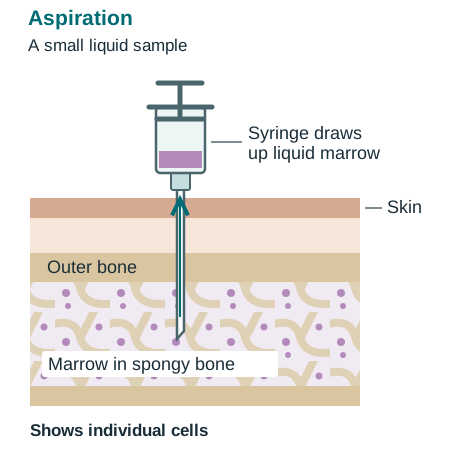
Bone marrow aspiration
A needle and syringe draw out a small amount of liquid marrow. The sample contains individual blood-forming cells.
The laboratory studies their appearance, the different cell types and how they are developing. Portions of the sample may also be used for specialised cell, chromosome or gene tests.
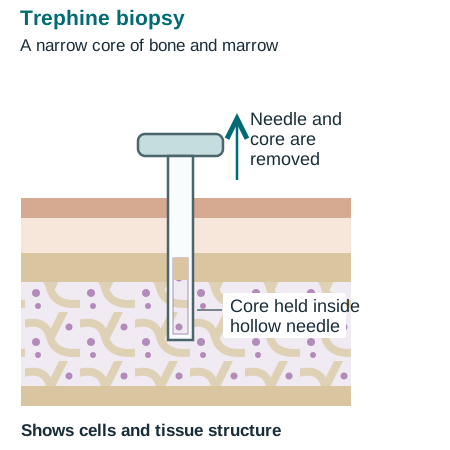
Bone marrow trephine biopsy
A hollow sampling needle collects a narrow core of bone containing marrow. “Trephine” is the name for this type of core biopsy.
It keeps the tissue structure intact. This shows how the cells are arranged, whether the marrow is too crowded or has too few cells, and whether there is scarring or abnormal tissue.
Why might I need both?
The liquid sample gives a close-up of the cells. The core shows the tissue around them. Together, they often give a more complete answer than either sample alone. A core can be particularly helpful when cells are unevenly distributed or liquid marrow is difficult to collect.
Sometimes only one procedure is needed. When both are requested, they are usually done at the same appointment, using the same cleaned and numbed area. The exact needle technique can vary.
Where and how are the samples taken?
In adults, the usual site is the back of the pelvic bone, also called the back of the hip bone or posterior iliac crest. This is not the spine. The needle enters the bone to reach the marrow; it does not enter the spinal cord.
Before your appointment
A little planning helps the visit run smoothly. Ask for your own unit’s instructions, especially if you will have sedation.
- Share your medicine list. Include cancer treatment, blood-thinning medicines, aspirin, painkillers, supplements and herbal remedies. Do not stop or change any medicine yourself. Ask whether anything needs to be paused, and exactly when to restart it.
- Mention allergies and previous problems. Tell the team about unusual bleeding, reactions to anaesthetics or dressings, or a difficult previous procedure.
- Check eating and drinking instructions. With local anaesthetic alone, you can often eat and drink normally. Sedation or an anaesthetic may require fasting. Follow the instructions you are given.
- Discuss comfort beforehand. Additional pain relief or sedation may need to be arranged before the day. You can ask about a companion, an interpreter or help with positioning.
- Plan your journey home. If you are having sedation, arrange for a responsible adult to accompany you and stay with you as instructed. Let the unit know if this will be difficult.
Your team reviews your blood results and individual bleeding risk. If your platelets are low or you take blood thinners, ask what precautions are needed; do not assume the test must be cancelled.
Your appointment, step by step
Sampling is usually done in a procedure room, outpatient department, day unit or ward. The procedure commonly takes about 20–30 minutes; collecting the samples occupies only part of that time. Allow longer for preparation, checks and recovery, especially with sedation.
- Confirming the plan. The clinician checks your details, explains why the test is needed and confirms whether you need an aspirate, a core, or both. There is time to ask questions before giving consent.
Getting settled. You usually lie on your side with your knees gently bent, or sometimes on your front. The team helps you find a supported position and keeps you covered apart from the area being tested. Tell them if arthritis, breathlessness or another problem makes a position difficult.
They may check your pulse, blood pressure and other observations. With intravenous sedation, a small cannula is placed in a vein and you are monitored.
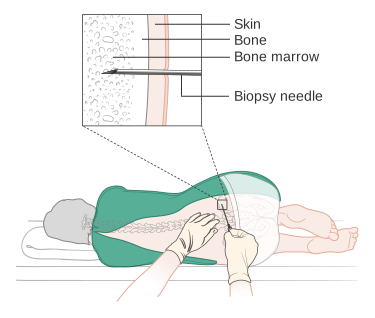
Side-lying position. Illustration: Cancer Research UK / Wikimedia Commons, CC BY-SA 4.0. - Cleaning and numbing. The skin is cleaned with antiseptic. Local anaesthetic is injected into the skin and deeper tissues, including the surface of the bone. The clinician allows it to work before proceeding.
- Taking the liquid sample, if needed. A needle is guided into the marrow and a syringe draws out a small amount of fluid. More than one small collection may be needed to provide enough material for the requested laboratory tests.
- Taking the core, if needed. A hollow biopsy needle is gently advanced with a turning movement to collect a narrow piece of bone and marrow. The sample comes out inside the needle. This is not an operation to remove a large piece of bone.
- Finishing and checking. The needle is removed, pressure is applied and a dressing covers the puncture site. You rest while the team checks the area and makes sure you feel well enough to leave.
How will the team keep me comfortable?
Local anaesthetic is used to numb the sampling area. The injection may sting briefly. As liquid marrow is drawn out, some people feel a short pulling sensation or sharp discomfort, sometimes extending into the leg. With the core biopsy, you may feel pressure, a turning sensation or an ache.
These experiences vary. Tell the team if you are uncomfortable. They can pause, check the local anaesthetic and adjust the plan. You do not have to keep quiet or try to “be brave”.
Depending on your needs and the facilities, options may include additional pain relief, gas and air, or sedation. Sedation helps you relax and may make you sleepy; it does not always mean being fully asleep. A general anaesthetic is a different option and is not routinely necessary for most adults.
Slow, comfortable breathing, listening to music or talking with a staff member may also help. These approaches can help you feel more comfortable alongside appropriate pain relief. Agree how you will let the clinician know if you need a pause.
What happens to the samples in the laboratory?
The samples are labelled with your details and sent with information about the question your doctor is trying to answer. Different portions may go to different laboratory sections. A specialist in blood and marrow diagnosis brings the findings together. Not everyone needs every test below.
1. Looking at cells in the liquid sample
A small amount of liquid marrow is spread thinly on glass slides and coloured with laboratory stains. Under a microscope, the specialist examines the size, shape and appearance of the cells, their stages of development and the balance of different cell types.
This helps show whether blood cells are developing as expected and whether abnormal cells are present. The findings are compared with your full blood count and blood film. The study of the cells’ appearance is called morphology.
2. Looking at the structure of the core biopsy
The core is placed in a preserving fluid. The laboratory usually softens its mineralised bone, a step called decalcification, so that it can be cut into very thin sections. The tissue is usually set in wax, cut into thin slices, placed on slides and coloured with laboratory stains.
This shows the overall marrow pattern: how much space contains blood-forming cells, how cells are grouped, and whether there is scarring or an unusual collection of cells. Special stains may help identify particular cells or tissue changes. These preparation steps are one reason the core report takes longer than an initial look at the liquid sample.
3. Identifying cells more precisely
Flow cytometry checks the pattern of proteins on or inside cells from a liquid sample. Cells are tagged in the laboratory and passed through an analysing machine. This can distinguish cell types that look similar under a microscope.
Immunohistochemistry (IHC) uses special stains to identify proteins in the tissue sections. It helps show both what particular cells are and where they sit within the core. These tests can help identify the exact type of a blood or marrow disorder.
4. Checking chromosomes and genes, when needed
Chromosomes contain genes, which carry instructions for cells. Some blood conditions have characteristic changes in these instructions.
- Chromosome analysis, or karyotyping: looks for changes in the number or structure of chromosomes. Cells may need to grow in the laboratory before they can be examined.
- Tests for selected chromosome or gene changes: some use fluorescent labels to look for particular changes. They do not check every possible change.
- Molecular or gene tests: look for changes in the cells’ genetic material. Some focus on one change; others examine several genes together.
These results may refine the diagnosis, help select treatment or provide a marker that can be followed later. A genetic change in marrow cells does not automatically mean an inherited condition. If inherited risk is suspected, your team will explain whether separate testing and genetic counselling are appropriate.
5. Checking response after treatment
For some blood cancers, a specially designed test looks for very small amounts of disease left after treatment. This is called measurable residual disease (MRD) testing. It may use flow cytometry or a molecular method.
MRD testing is not needed in every situation. “Not detected” means the test did not find disease within the limits it can measure. Your doctor considers this alongside other findings when explaining how treatment is working and what care or follow-up is needed.
How long do bone marrow test results take?
Results often arrive in stages, not as one immediate answer. Some early information may be available within 24–48 hours, while the main marrow assessment often takes around one to two weeks. Specialised tests can take longer. Your own laboratory’s expected dates are the best guide.
Extra time may be needed to prepare tissue, grow cells for chromosome analysis, complete additional stains, check a finding or obtain a specialist opinion. A longer wait does not, on its own, mean a more serious result. Urgent findings may be communicated before every part of the report is complete.
How will the results be explained?
Your haematologist or oncologist considers the marrow findings alongside your symptoms, blood tests and any relevant scans. You may receive an initial report followed by additional results.
Ask which results are back, which are still pending, and whether there is enough information to decide the next step. If treatment is urgent, your doctor will explain what can safely start while further tests are completed.
A report in a patient portal may appear before your appointment. Technical wording or a flagged value is not a complete explanation of what it means for you. Keep a copy and discuss it with your team. If you have not heard by the agreed date, contact them rather than waiting indefinitely.
Going home and recovering
Most people go home once the team has checked the site and they feel well enough. After sedation, you need longer observation until you have recovered sufficiently. If you feel faint or unsteady, ask for help before getting up.
A small bruise or an ache at the site can last for a few days. Your team will recommend suitable pain relief; paracetamol may be an option. Ask before adding aspirin, ibuprofen or other anti-inflammatory painkillers, especially if your platelet count is low. Follow the separate advice for medicines you already take.
- Keep the dressing clean and dry for the advised period, commonly 24 hours. Check when you can shower or bathe.
- Gentle everyday activity is often possible once you feel steady. Ask when to resume strenuous exercise, heavy lifting or physical work.
- After sedation, do not drive, drink alcohol or operate machinery for at least 24 hours, or longer if instructed. Arrange adult support at home as advised.
Before leaving, make sure you have your aftercare instructions, a contact number and the plan for discussing results. Your own unit’s instructions take priority.
Are there risks, and when should I ask for help?
Bone marrow sampling is generally safe. The main possible complications are bleeding and infection; serious complications are uncommon. Your individual risk depends partly on your blood counts, medicines and general health. Sedation or anaesthetic medicines have their own risks, which the team discusses and monitors.
Frequently asked questions
Does needing a bone marrow biopsy mean I have cancer?
No. It is a way to find an explanation, not a diagnosis in itself. Both cancerous and non-cancerous conditions can affect blood-cell production. Your doctor will explain what they are checking for.
Can a blood test or scan replace the marrow test?
Sometimes other tests answer the question. But blood tests and scans do not always show the cells and tissue structure inside the marrow in enough detail. Ask what the marrow examination adds and whether an alternative would give the information needed.
Is this a spinal test or a bone marrow transplant?
No. It takes small samples from blood-forming tissue inside a bone, usually the pelvis. A lumbar puncture samples fluid around the brain and spinal cord. Marrow donation and stem cell transplantation are also different procedures.
Can I ask for sedation or more pain relief?
Yes. Discuss your preferences and any previous difficulties before the appointment. Ask what is suitable and available, whether you need to fast, and how it affects transport and recovery. Sedation does not always mean being fully asleep.
What is a “dry tap”?
It means liquid marrow could not be drawn out easily. This can happen for different reasons and is not a diagnosis by itself. The core biopsy and other material may still provide useful information. Your clinician will explain whether another sample is needed.
Why might the test need to be repeated?
A repeat test may assess response to treatment or investigate a new change. Occasionally, the first sample does not provide enough information. Ask what repeating it would add and whether existing samples can answer the question.
Do I need to stay in hospital overnight?
Usually not for the test itself. Your stay may be longer if you have sedation, need extra monitoring or are already unwell. Ask the unit how much time to allow and what support you need at home.
Can someone come with me?
A companion can help you remember instructions and get home safely. Ask whether they can stay in the procedure room, as arrangements differ. After sedation, an accompanying adult is usually required even if you travel by taxi.
Does a delay in the report mean something is wrong?
Not necessarily. Different laboratory tests finish at different times, and some need extra processing or review. Ask what is still pending and when to expect an update. A delay alone cannot tell you what the result will show.
Can I get a second opinion on the results?
Yes. Discuss how to arrange specialist review of the reports, slides and, if needed, the tissue block. Existing material can often be reviewed without immediately repeating the procedure. The receiving laboratory will advise what it needs.
Five questions to take with you
- Why do I need this test, and do I need both aspiration and biopsy?
- What should I do about my medicines, food and drink?
- What comfort measures can we arrange?
- Which laboratory tests are planned, and when should each result be ready?
- Who will explain the results, and whom should I contact after the procedure?
You do not need to understand every laboratory term before your appointment. What matters is knowing why the test is being done, what support is available and when you will hear about the results. The test is a step towards a clearer explanation and a care plan based on your needs.
Sources and further reading
- American Cancer Society. Blood cells and bone marrow; Bone marrow biopsy and aspiration; biopsy and laboratory testing; marrow testing in MDS.
- Cancer Research UK. Bone marrow test.
- Macmillan Cancer Support. Bone marrow biopsy.
- National Cancer Institute. Bone marrow; Aspiration and biopsy; diagnostic tests; pathology reports; biomarker testing; measurable residual disease.
- MD Anderson Cancer Center. Bone marrow biopsy explained: process, pain management and results.
- Blood Cancer UK. Blood cancer tests.
- Naresh KN et al. Optimal processing of bone marrow trephine biopsy: the Hammersmith Protocol. Journal of Clinical Pathology. 2006;59:903–911. Used for the principles of tissue processing and assessment.
- Rack KA et al. European recommendations and quality assurance for cytogenomic analysis of haematological neoplasms. Leukemia. 2019;33:1851–1867. A laboratory-method reference also cited by Cancer Research UK.
Medically reviewed and approved by Dr (Prof) Vijay Agarwal
Professor and Lead Consultant – Medical Oncology

