
Share
When cancer is diagnosed, a family often asks: “Could my children or siblings get this too?” Another patient may wonder why genetic testing is suggested when nobody else in the family has cancer.
Most cancers are not caused by a single inherited cancer-predisposition syndrome. However, identifying an inherited harmful gene change can sometimes influence treatment, guide future screening and help relatives understand their own risk. The purpose is to make useful decisions—not assign blame or predict every person’s future.
Cancer is genetic, but not always inherited
Cancer develops when changes in cells affect growth and behaviour. Many of these changes accumulate during life and are found mainly in the tumour. They are called somatic changes.
A germline change is present in the person’s constitutional DNA and may be inherited through a family. A harmful variant in a cancer-predisposition gene can increase the risk of particular cancers, but usually does not make cancer inevitable. NCI estimates that about 5–10% of cancers are caused by inherited harmful genetic changes.
Families can share risks without a single identifiable syndrome. Tobacco, infections, environment, age and chance can contribute to several relatives developing cancer. Conversely, a hereditary predisposition can be present despite few known family diagnoses.
Which patterns make inherited risk more likely?
The pattern matters more than simply counting relatives. Cancer at an unusually young age, related cancers in several relatives, multiple primary cancers in one person, certain rare tumours or a known family variant can raise suspicion.
Some diagnoses justify considering testing even without a striking family history. The exact criteria vary by cancer, age, stage and guidance. A brief online checklist cannot substitute for assessment.
Small families, incomplete history and relatives dying young from other causes can hide an inherited pattern. Both sides of the family matter. A father can pass on a BRCA-related predisposition just as a mother can. Men may themselves face risks from relevant variants.
Tell the clinician where relatives’ cancers began and their approximate ages at diagnosis. “Abdominal cancer” or “bone cancer” may describe spread rather than the original tumour. Obtain records when practical, but do not postpone asking for advice because details are incomplete.
How is inherited testing different from tumour profiling?
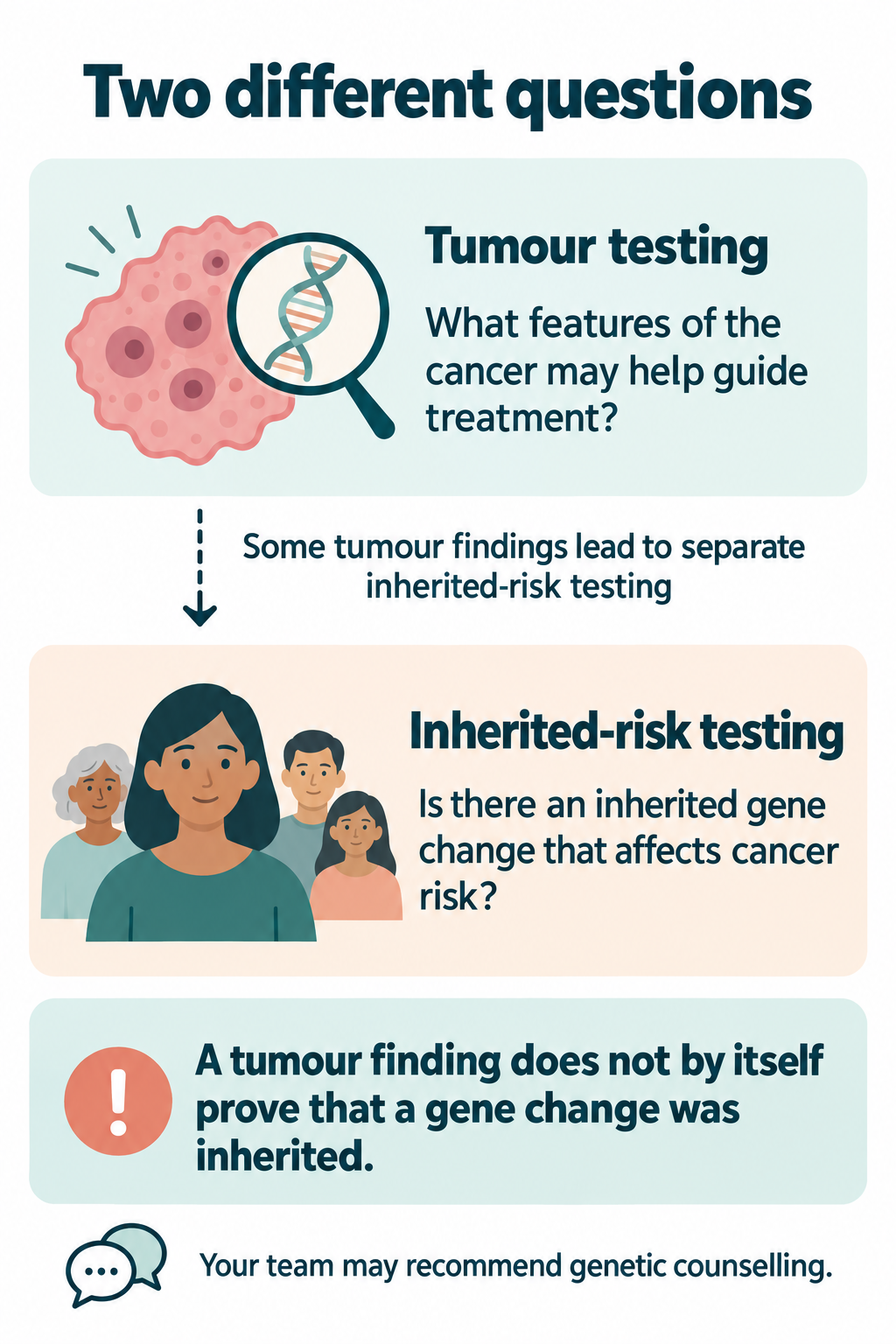
View full-size diagram
If the table extends beyond your screen, swipe or scroll sideways to read every column.
Question | Tumour profiling | Germline genetic testing |
|---|---|---|
What is studied? | Features of cancer cells, often including acquired alterations | Inherited variants that may affect cancer risk |
Typical sample | Tumour tissue; sometimes tumour-derived material in blood | Usually blood or saliva, with special exceptions |
Main purpose | Classification and treatment selection | Risk assessment, family advice and sometimes treatment decisions |
Does it directly answer relatives’ risk? | Usually not without further assessment | It may when a clinically significant inherited variant is identified |
A gene name on a tumour report is not proof of inheritance. Confirmation may be needed. Equally, an uninformative tumour panel does not exclude all hereditary syndromes.
People with blood cancers or a previous donor stem-cell transplant may need specialist advice about the correct sample. Tell the genetics team the full treatment history rather than assuming any blood sample will answer the inherited-risk question.
What can a result change for the patient?
Depending on the gene and cancer, it may influence drug selection, surgical planning, surveillance for another cancer or prevention discussions. It is not only information for relatives, but neither does every result alter current treatment.
A finding may prompt screening for a risk not previously recognised or support a treatment option in a defined setting. Its value comes from connecting it to a recognised care pathway.
Major decisions such as preventive surgery need discussion of absolute risk, alternatives, age, fertility, menopause, recovery and personal priorities. A positive laboratory result is not an instruction to have immediate surgery.
Why genetic counselling matters
Before testing, a genetics professional or appropriately trained clinician should explain the intended question, genes being examined and possible results. Discuss implications for relatives, consent, privacy and uncertain findings.
Some patients primarily want to guide treatment; others worry most about their children. Naming that priority helps. Ask how results will be returned, whether written family information will be provided and who will help if the interpretation changes.
Testing is a choice. The clinician should explain why it is recommended and what may remain uncertain without it, without presenting it as a moral obligation to the family.
Positive, negative and uncertain results mean different things
A pathogenic or likely pathogenic result identifies a harmful or probably harmful variant. It calls for gene-specific advice, not a prediction of exactly when cancer will occur. It does not mean every relative carries the variant.
A true negative is particularly informative when a family variant is already known and a relative does not carry it. That person does not have increased risk from that particular variant, although other risks still matter.
An uninformative negative means no cause was found without necessarily having a known family variant to test against. It does not erase a strong family history or exclude every inherited predisposition.
A variant of uncertain significance, or VUS, has an unestablished meaning. It should not by itself justify major preventive surgery or label relatives as having a confirmed syndrome. It may later be reclassified as evidence develops.
Ask what kind of result you received and what should change because of it. A short message saying “negative” can leave out important context.
Who should be tested first?
When possible, hereditary-cancer assessment begins with an affected family member. This is more likely to identify an informative finding than testing an unaffected relative first. If a harmful variant is found, relatives can have focused cascade testing.
In many common inherited cancer syndromes, each child has a one-in-two chance of inheriting a relevant parental variant. This is an inheritance probability, not a one-in-two prediction of cancer. The actual cancer risk depends on the gene and other factors; not every syndrome follows this pattern.
A family letter from the genetics service can explain the relevant test without asking the patient to interpret technical findings for everyone. Each adult relative should be able to make an informed choice.
Should children be tested?
Testing is usually considered in children when the result could change care during childhood. For many adult-onset syndromes, it is deferred until the person can participate in the decision and screening would become relevant. Childhood cancer-predisposition syndromes are important exceptions.
Ask for gene-specific advice rather than requesting a broad panel for every child. Emotional and practical consequences deserve the same care as the laboratory process.
Can a consumer DNA kit answer the question?
Consumer tests may examine only selected variants and miss the genes or alterations relevant to a particular family. A reassuring consumer result does not exclude hereditary cancer risk, and unexpected findings may need clinical confirmation before decisions are made.
Ask who interprets the test, whether counselling is included, how the sample and data are used and whether the result is suitable for medical decisions. Privacy and insurance protections differ between countries; an explanation of US law should not be assumed to apply in India.
What should happen after testing?
Leave with a written plan: what the result means, which screening or prevention measures are recommended, when they begin and who coordinates them. Clarify which relatives should be offered counselling or testing.
Continue ordinary prevention and appropriate screening even after a reassuring result. A gene test does not replace attention to symptoms or recommended cervical, breast or bowel screening. Equally, extra testing should follow a meaningful risk assessment rather than anxiety alone.
Reassessment may help if another relative develops cancer, previous testing was limited or a variant’s interpretation changes. Keep the full report, not just a verbal summary.
Frequently asked questions
Did I pass cancer to my children?
Cancer itself is not passed down this way. Some families share a predisposition that increases risk. Nobody chooses the genes they inherit or pass on, and a result is not a reason for blame.
Is testing unnecessary without family history?
No. Particular diagnoses can justify it, and family history may be incomplete. The decision should consider the full clinical situation.
Does BRCA matter only for women?
No. Relevant variants can be inherited and transmitted by men and women and affect risks beyond breast and ovarian cancer. Advice depends on the specific gene and person.
Can testing wait until treatment finishes?
Sometimes, but it can influence present treatment or surgical decisions. Ask whether it is time-sensitive before postponing it.
The value of genetic testing is knowing what the information should—and should not—change for the patient and family.
Sources and further reading
- NCI: Genetic testing for inherited cancer risk
- NCI: BRCA gene changes: cancer risk and genetic testing
- NCI: Biomarker testing for cancer treatment
- NCI: Questions to ask your doctor about cancer
Medically reviewed and approved by Dr (Prof) Vijay Agarwal
Professor and Lead Consultant – Medical Oncology
For patient education, not individual medical advice. Read our Medical Disclaimer.