
Share
CAR-T cell therapy can produce profound and sometimes long-lasting responses in selected blood cancers. Describing it as a single infusion, however, misses most of what a patient and family need to understand. It is a pathway involving assessment, collection, manufacture, preparation, infusion, close monitoring and longer-term recovery.
The decision is not simply whether CAR-T is available. It is whether a particular product fits the cancer, whether this is the right point in treatment and whether clinical and practical arrangements can support the patient safely.
What does CAR-T mean?
CAR stands for chimeric antigen receptor. T cells are immune cells capable of attacking abnormal cells. In the usual established pathway, a patient’s T cells are collected and modified so they carry a receptor recognising a target on cancer cells. They are expanded and returned by infusion.
These are living cells, not an ordinary manufactured antibody or chemotherapy medicine. They may multiply and continue acting after infusion, contributing to both benefit and risk.
Many established products use the patient’s own cells—an autologous approach. Donor-derived and other engineered-cell strategies are also being investigated. Check the exact evidence and status of a product described as off-the-shelf rather than assuming it is equivalent.
Which cancers can it treat?
Established uses are mainly in selected B-cell malignancies, including particular lymphomas, acute lymphoblastic leukaemia and multiple myeloma. Eligible subtype, age, previous treatment and treatment line differ by product and country. Not every blood cancer is an indication.
For most common solid cancers, CAR-T remains investigational. Other cellular treatments, such as tumour-infiltrating lymphocyte therapy, are not the same thing. “Cell therapy” should not conceal these distinctions.
Before travel or financial commitments, ask the team to name the proposed product and explain whether it is established care, a context-dependent option or part of a clinical trial.
Is it always a last resort?
No. In some diseases CAR-T has moved earlier in the treatment pathway. An early specialist discussion can clarify timing, even when treatment is not immediately required. Waiting until someone becomes too unwell can sometimes remove an opportunity.
Equally, it is not automatically preferable to every established alternative. At relapse, the discussion may include other systemic therapies, transplantation, antibody-based treatments or research options.
Ask what would be recommended without CAR-T and why the balance favours one approach. The consultation should compare options rather than simply promote a technology.
How is suitability assessed?
The team reviews the precise disease, target, previous treatment, current disease activity and ability to tolerate the pathway. Organ function, infections, neurological history, blood counts and overall fitness may matter. Disease control during manufacturing must also be considered.
A caregiver, transport, nearby accommodation when required and access to urgent assessment are part of safety planning, not minor administration.
Not being eligible for one product or protocol does not mean no treatment is possible. Ask what specific factor prevents treatment and whether optimisation, another approach or a trial may be reasonable.
What happens from referral to infusion?
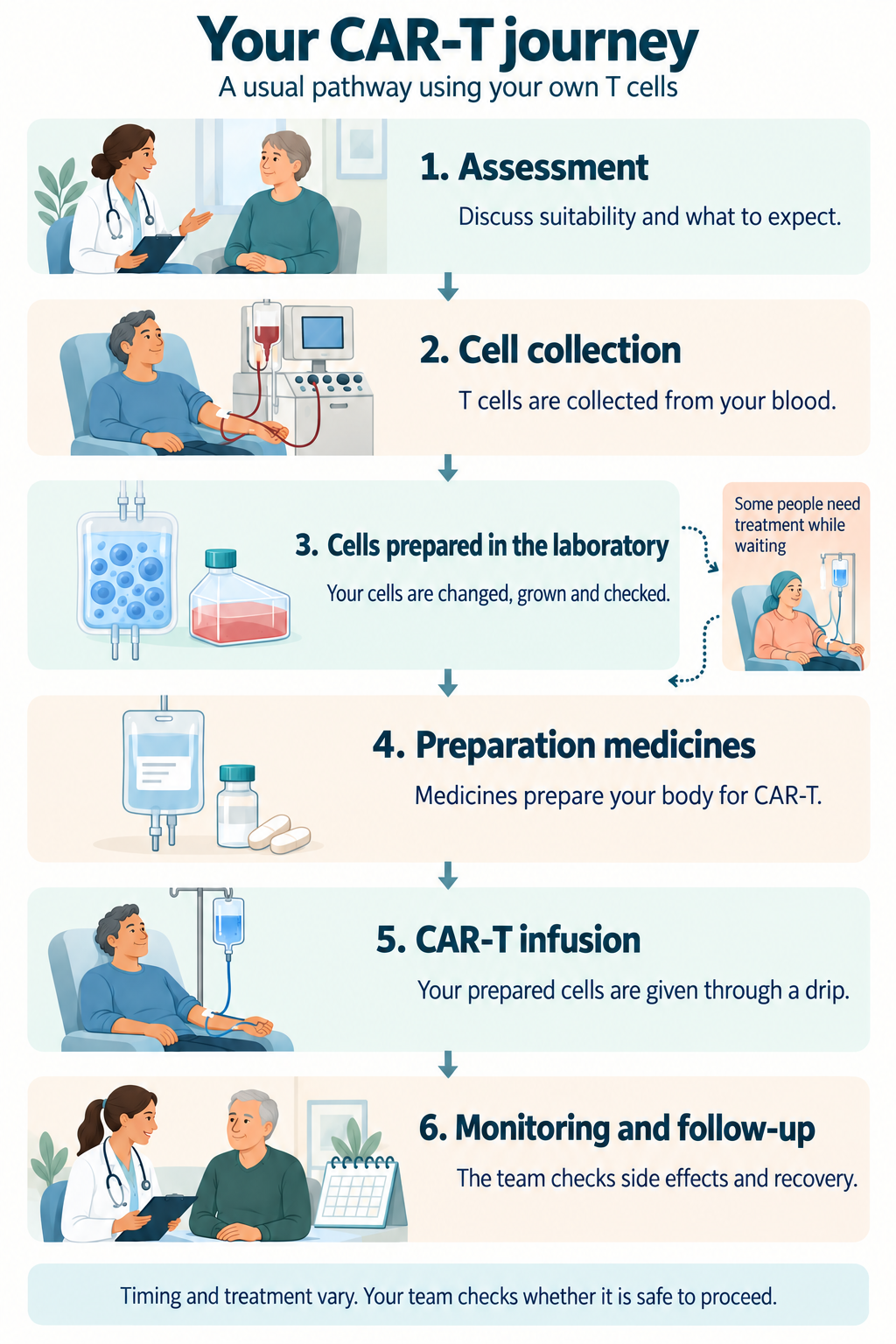
View full-size diagram
If the table extends beyond your screen, swipe or scroll sideways to read every column.
Stage | What happens | What to clarify |
|---|---|---|
Assessment | Diagnosis, health and alternatives are reviewed | Why this product, and why now? |
Cell collection | An apheresis machine collects the required cells from blood | Is special venous access needed, and how long does collection take? |
Manufacture | Cells are modified, expanded and checked | What is the expected wait, and what happens if manufacture is unsuccessful? |
Bridging treatment, if needed | Temporary therapy controls cancer during the wait | How is it coordinated with collection and infusion? |
Lymphodepletion | A preparatory course helps create a suitable environment for the cells | Which medicines and side effects should be expected? |
Infusion and monitoring | The cells are returned, followed by close observation | Where will monitoring occur, and who needs to stay nearby? |
Manufacturing commonly takes weeks, but the actual timetable should come from the centre. The patient’s condition can change during this interval, so reassessment remains important.
Why is chemotherapy used beforehand?
Lymphodepleting chemotherapy is intended to prepare a suitable environment for the CAR-T cells. It is different from bridging therapy used to control the cancer while manufacture takes place.
Receiving chemotherapy before CAR-T is not necessarily contradictory even when earlier chemotherapy failed to give durable control. The preparatory medicines may be serving a different purpose.
Ask the team to explain which part of the schedule is preparation and which part is directly controlling cancer. It helps make sense of the sequence and expected side effects.
What are CRS and ICANS?
Cytokine-release syndrome, or CRS, is an inflammatory reaction associated with immune-cell activation. It can cause fever, low blood pressure, oxygen problems and other systemic effects. Severity varies, and some patients need intensive monitoring or treatment.
Immune effector cell-associated neurotoxicity syndrome, or ICANS, describes neurological complications that can include confusion, difficulty with words or handwriting, reduced alertness or seizures. These changes require prompt assessment, not unaided observation at home.
Fever may also signal infection and should not automatically be dismissed as expected CRS. The centre should provide a clear emergency pathway for patients and caregivers, including outside normal clinic hours.
What other risks require follow-up?
Low blood counts, infection susceptibility and reduced antibody-producing immune cells can persist beyond the early period. Preventive medicines, blood testing, transfusions or immunoglobulin replacement may be considered according to the product and recovery.
Long-term safety matters too. The FDA requires warnings about secondary T-cell malignancies for relevant BCMA- and CD19-directed autologous CAR-T products and advises lifelong monitoring for secondary cancers. This uncommon but serious issue must be balanced against the original cancer risk and expected benefit; it does not mean every recipient develops another cancer.
Ask which long-term checks apply and who will organise them when care is shared with a local team.
Why is a caregiver often needed?
A caregiver may notice changes the patient does not recognise, help manage medicines and obtain urgent assistance. Travel, driving and proximity-to-centre restrictions vary by product and programme. Follow the current instructions rather than an old generic internet timetable.
Plan time away from work, accommodation and an alternative caregiver if the main person becomes unwell. Do not book a return flight solely around the infusion date: discharge, fitness to travel and completion of required monitoring are separate decisions.
Is CAR-T the same as a stem-cell transplant?
No. A stem-cell transplant restores blood-forming cells after particular treatments; a donor transplant can also produce an immune effect against cancer. CAR-T modifies immune cells to recognise a chosen target. Both require specialist infrastructure but have different mechanisms and risks.
Some patients may be considered for both at different points. The comparison should be specific to the disease and prior treatment rather than a general contest between technologies.
What does a complete response mean?
A complete remission can be important and sometimes durable, but it is not an immediate guarantee of cure. Some patients do not respond, some relapse and some need additional treatment. Outcomes vary substantially between cancers, products and treatment settings.
Ask for outcomes in patients comparable to you. A headline response rate may not show how long responses lasted, how many referred patients reached infusion or what serious risks occurred.
Follow-up assesses both the cancer and immune recovery. Feeling better after infusion does not remove the need for disease-specific tests and longer-term monitoring.
What should a cost discussion include?
Request an estimate covering assessment, collection, manufacture, bridging and preparatory therapy, monitoring, possible admission or intensive care, supportive medicines, accommodation and follow-up.
Ask what happens if manufacture fails, disease progresses before infusion or treatment is delayed. Available products, insurance and import requirements differ between countries. An overseas approval does not establish local access.
These practical discussions help families decide without discovering major barriers halfway through a complex process.
Frequently asked questions
Is one infusion the whole treatment?
No. Many established pathways use one planned cell infusion, but preparation and prolonged follow-up are essential parts of the course. Additional or repeat treatment is an individual decision.
What happens to vaccination afterwards?
Immune recovery can be prolonged and previous protection reduced. Vaccination or revaccination needs a specialist plan; live vaccines should not be arranged independently.
Does CAR-T change genes passed to children?
The standard process modifies the collected treatment cells, not eggs or sperm. Previous and preparatory treatment may still affect fertility, so fertility and pregnancy planning deserve discussion.
When can normal work resume?
It depends on recovery, blood counts, infections, fatigue, neurological effects and the job. Ask for a staged plan rather than treating discharge as an automatic return to full activity.
CAR-T is a carefully coordinated treatment pathway—not a universal cure or a substitute for long-term specialist follow-up.
Sources and further reading
- NCI: CAR T cells: engineering immune cells to treat cancer
- NCI: T-cell transfer therapy
- FDA: secondary T-cell malignancy warnings after BCMA- or CD19-directed CAR-T therapy
- ASCO: vaccination of adults with cancer (2024)
- NCI: Infection and neutropenia during cancer treatment
Medically reviewed and approved by Dr (Prof) Vijay Agarwal
Professor and Lead Consultant – Medical Oncology
For patient education, not individual medical advice. Read our Medical Disclaimer.