

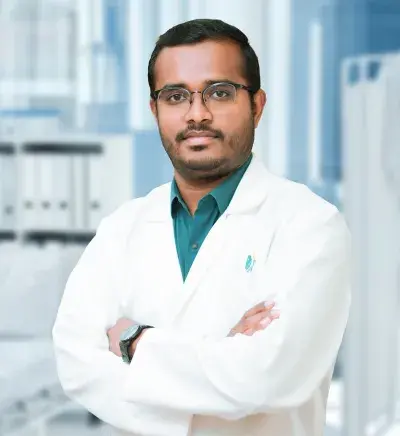
A clinical foundation in general medicine followed by advanced oncology training.
Dr Darshan R S completed his MBBS at Raichur Institute of Medical Sciences, Karnataka. After building his initial clinical experience through an internship at the same institution, he pursued an MD in General Medicine at RNT Medical College in Udaipur, Rajasthan.
He subsequently worked as a Senior Resident at RNT Medical College. This experience strengthened his ability to manage complex medical conditions and understand how a patient’s overall health can influence treatment decisions.
From January 2023 to January 2026, Dr Darshan undertook DM training in Medical Oncology at Kidwai Memorial Institute of Oncology. Since February 2026, he has been working as an Associate Consultant at Apollo Hospitals on Bannerghatta Road, Bengaluru.
Cancer treatment guided by diagnosis, evidence and individual needs.
Cancer diagnosis and assessment
Cancer treatment begins with an accurate understanding of the disease. Dr Darshan reviews clinical findings, pathology, imaging and other relevant test results before recommending the next step.
Chemotherapy
Selection and administration of chemotherapy based on the cancer type, stage, treatment objective and the patient’s overall fitness. Response and possible side effects are monitored throughout treatment.
Immunotherapy
Consideration of immunotherapy when supported by the diagnosis, disease characteristics and available medical evidence. Patients receive clear information about expected benefit and limitations.
Targeted therapy
Use of medicines designed to act on specific molecular or biological features of a cancer when suitable targets are identified and treatment is clinically appropriate.
Personalised cancer care
Treatment decisions take into account more than the diagnosis alone. Age, general health, previous treatment, test findings and individual priorities are considered while developing the care plan.
A consultation focused on clarity and informed decisions.
A cancer diagnosis can bring unfamiliar terminology and several difficult choices. Dr Darshan aims to make the process more understandable by explaining the diagnosis, available treatment options and why a particular approach may be recommended.
Evidence before recommendation
Treatment is planned using current medical evidence, accepted oncology practices and the specific clinical details of the patient.
The complete health picture
Existing medical conditions, general fitness, previous treatment and current symptoms are reviewed because they may affect treatment selection and tolerance.
Personalised planning
The same cancer can behave differently from one patient to another. Treatment is adjusted according to disease characteristics and the patient’s individual situation.
Compassionate support
Clear communication and practical support remain important throughout treatment, particularly when patients and families are managing uncertainty or complex medical decisions.
Medical and oncology experience across Karnataka and Rajasthan.
Associate Consultant at Apollo Hospitals, Bannerghatta Road, involved in the assessment and treatment of patients requiring medical oncology care.
Undertook DM training in Medical Oncology, gaining focused experience in cancer diagnosis, systemic treatment and oncology decision-making.
Worked as a Senior Resident after completing postgraduate training in General Medicine.
Completed a rotating medical internship, developing practical experience across core clinical specialties.
Qualifications
- DM training in Medical Oncology, Kidwai Memorial Institute of Oncology – January 2023 to January 2026
- MD in General Medicine, RNT Medical College, Udaipur – 2018 to 2021
- MBBS, Raichur Institute of Medical Sciences, Karnataka – 2011 to 2015
- Internship, Raichur Institute of Medical Sciences – March 2016 to March 2017
Research connecting oncology with broader medical care.
Dr Darshan has contributed to research across oncology and internal medicine. His academic work examines diagnostic and prognostic markers that can help clinicians understand disease severity, anticipate outcomes and make more informed treatment decisions.
Cancer biomarkers and treatment response
His oncology research includes the significance of BRAF V600E mutations in patients with melanoma. This area is relevant to understanding tumour biology and identifying patients who may be considered for specific targeted treatments.
Liver disease assessment
One study investigated the relationship between non-invasive markers of liver fibrosis and cirrhosis, including the APRI, MELD and Child-Pugh scores. Such tools may help clinicians assess disease severity without relying on a single measurement.
Diabetes and vascular complications
His work on platelet indices explored their correlation with HbA1c and their association with microvascular complications in people with type 2 diabetes mellitus.
Critical care and prognosis
Dr Darshan has compared red cell distribution width with the APACHE II score as prognostic markers among patients with sepsis and septic shock at a tertiary care centre in Southern Rajasthan.
Other research interests
His additional work includes thyroid dysfunction in patients with chronic obstructive pulmonary disease and the possible use of serum ferritin as a surrogate marker for CD4 levels in people living with HIV.
Beyond the Consulting Room
Dr Darshan’s academic work reflects an interest in how laboratory values, biomarkers and clinical scoring systems can guide treatment and prognosis. His research spans oncology, chronic illness, infectious disease and critical care, giving him a broad clinical perspective when assessing patients with cancer and other medical conditions.
Oncology researcher
Contributor to studies involving melanoma mutations and predictors of treatment response in rectal cancer.
Evidence-focused clinician
Interested in clinical markers that can help evaluate disease severity, treatment response and likely outcomes.
General medicine perspective
His postgraduate background supports a wider assessment of medical conditions that may influence cancer treatment.
Patient-focused communication
Committed to discussing treatment choices in accessible language so that patients and families can participate more confidently in care decisions.
Supporting the person throughout cancer treatment.
Dr Darshan combines evidence-based care with compassionate support. He explains the purpose of treatment, discusses suitable options and considers the patient’s overall health while planning the next step.
This approach helps keep treatment medically appropriate while ensuring that the patient remains central to the decision.